
Site guide
What base should a gaga pit sit on?
Almost anything firm and level. A gaga pit does not need a concrete slab, and many schools put theirs straight onto grass or asphalt. Here are the choices, what each is like to live with, and the one thing that matters whichever you pick: water has to drain away.
The short version
Level it, drain it, and choose a floor.
- Pick a level area about 9 m × 9 m (see the size guide)
- Check that water will run away from the pit, not into it
- Mark out the octagon and fix any high or low spots
- Build the walls on the prepared ground
- Choose and lay the floor inside
| Surface | What it is like | Watch for |
|---|---|---|
| Asphalt or paving | The simplest option. The pit sits straight on top with no preparation. | Needs to be level. It is a hard floor, so a soft ball is a good idea. |
| Compacted crushed rock or gravel | Drains well, stays firm and needs very little upkeep. A popular choice inside the pit. | Needs to be compacted once, and topped up occasionally. |
| Grass | Easy and cheap. The pit sits on the lawn. | The middle wears bare, and can get muddy after rain. |
| Mulch or bark | Soft underfoot and looks natural. | It moves and breaks down, so it needs topping up, and it can stick to the ball. |
| Synthetic turf | Cushioned and tidy. No mud. | The most expensive option, and it needs a level, drained base underneath. |
On a school yard
Asphalt and grass both work.
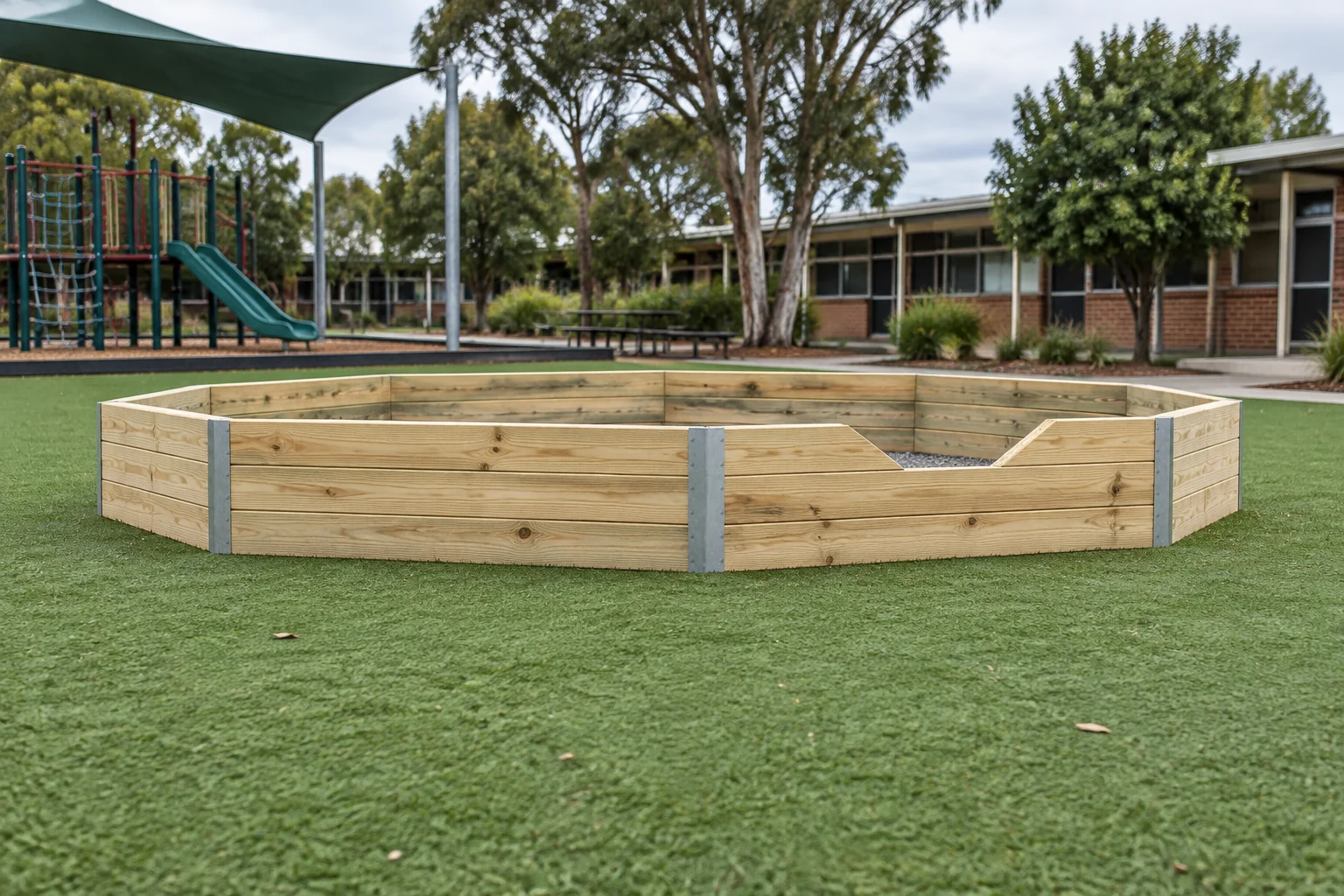
Plenty of pits sit on the existing yard with almost no site work. On asphalt you can build straight away. On grass, level the ground, then decide whether the play area inside stays as lawn or gets a crushed rock floor.
Crushed rock floor
The popular choice for the inside.
A layer of crushed rock, compacted, gives a firm floor that drains and is easy to rake smooth. Your local landscape or building supplier can tell you which grade of crushed rock suits compacting, and how much you need for a pit about 5.8 m across.
Drainage
The one thing not to skip.
Water that sits inside the pit makes the floor soft and muddy. Before you build, look at where rain will go. If the spot is the low point of your yard, pick another spot, or raise the floor a little with crushed rock so water drains out past the walls.
The standard build uses H4 treated pine, which is made for ground contact, so wet ground will not hurt the timber.
Frequently asked questions.
Does a gaga pit need a concrete base?
No. The pit is built from timber sleepers and steel brackets and does not need a slab. It can sit on grass, compacted gravel or crushed rock, mulch, synthetic turf, or on existing asphalt or paving.
Can a gaga pit go on grass?
Yes. Grass works well. The play area inside will wear bare over time, so many schools put a layer of compacted crushed rock or gravel inside the pit.
Can you build a gaga pit on asphalt?
Yes. If the asphalt is level, the pit can sit straight on it with no preparation. It is the simplest base of all.
What goes inside the pit?
The floor inside is up to you. Compacted crushed rock or gravel is a popular choice because it drains, stays firm and needs little upkeep. Asphalt, paving, synthetic turf and mulch also work.
How level does the ground need to be?
Level enough that the walls sit straight and the bottom sleeper is in contact with the ground all the way round. Mark the octagon first, then fix any high or low spots before you build.
Is the timber okay sitting on the ground?
The standard build uses H4 treated pine, which is made for ground contact. See the build guide and parts list for the full timber list.
Ready to plan?